UN Security Council Resolution 2797 on the Sahara: NAIntel Strategic Analysis #001
Resolution 2797 of the UN Security Council on the Sahara: perceptions, risks and opportunities
NorthAfrica Intel
11/5/20259 min read


Resolution 2797 on the Sahara – Strategic Analysis NAIntel #001
Introduction
The United Nations Security Council met on October 31, 2025, in New York for a meeting on the renewal of MINURSO.
The Council adopted Resolution 2797, which enshrines Moroccan autonomy in Western Sahara, by 11 votes in favor, 3 abstentions, and one member (Algeria) not participating in the vote.
The main actors concerned by this resolution are Morocco, which was not present during the vote and is promoting its autonomy plan, and Algeria, which supports the Polisario Front and the referendum option and was present during the vote in its capacity as a non-permanent member of the Security Council until December 31, 2025.
The main issue was that Resolution 2797 would strengthen Morocco's position, marginalizing Algeria's position and paving the way either for continued tensions between the two countries or, on the contrary, forcing the various players to seek a peaceful resolution to a dispute that has lasted more than 50 years.
Chronology of recent events
On October 17, 2025, the United States circulated a first draft resolution—which was leaked on X but appears to have since been deleted—describing Morocco's autonomy plan as the exclusive framework for negotiations, while reducing MINURSO's mandate to just three months.
On October 26, 2025, during closed-door consultations, Russia and China blocked the initial text on grounds of rewording, as the text was perceived as “unbalanced,” particularly by China. This led to a third draft.
On October 30, 2025, this new version reappeared on X, with a six-month extension of the mandate. Finally, a compromise was reached to extend the mandate for one year, describing Moroccan autonomy as a “realistic solution” while maintaining the reference to self-determination.
On October 31, 2025, Resolution 2797 was adopted with 11 votes in favor, 3 abstentions (Russia, China, Pakistan), and Algeria did not participate in the vote.
Social media - X in full turmoil
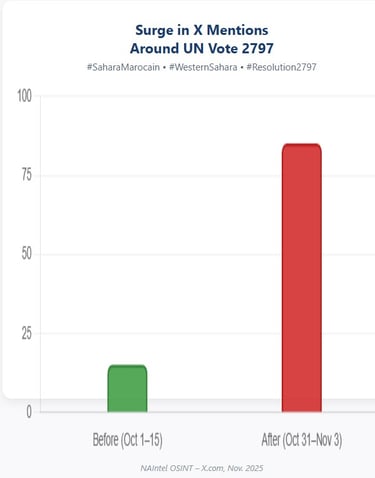
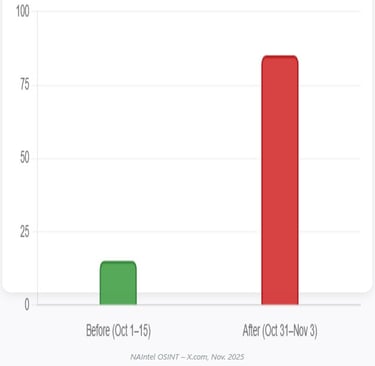
More than 1,200 posts were published on X in
48 hours concerning “Western Sahara UN 2025,” with
intense debates on the interpretation of each term in the
resolution, each side interpreting the resolution as a
victory.
Pro-Moroccan accounts such as @jafkesh, 30K followers,
hail it as "the most favorable resolution for Morocco
in the history of the conflict," while pro-Algerian accounts,
such as @springfield_dz, 13,3K followers, emphasize the
On Telegram, several pro-Polisario channels such as Sahara Press
Service are broadcasting Polisario statements denouncing
a “UN retreat.”
Perspectives on the Resolution
1. The Moroccan perspective
The resolution does not establish the autonomy plan as the “sole basis” (as hoped by Morocco) but as “the basis” for resolving the issue, and MINURSO's mandate, initially set to be renewed for three months, is ultimately renewed for one year.
However, this resolution consolidates de jure Moroccan sovereignty over the Sahara, as autonomy within the framework of an existing state is a form of self-determination recognized by the UN (Principle VI of Resolution 1541 of 1960).
The de facto situation on the ground already favors the Kingdom, which effectively controls 80% of the territory, with the remaining 20% serving as an uninhabited buffer zone.
2.The Algerian perspective
The international press unanimously interpreted the resolution as a diplomatic victory for Morocco. In Algeria, the opposite is true: the national and private media perceive it as a victory for Algerian diplomacy, which succeeded in modifying the US draft resolution and even forced its rejection by the Security Council.
In an interview on November 2, 2025, on AL24NEWS, Algerian Foreign Minister Ahmed Attaf welcomed the fact that the “autonomy plan is no longer the exclusive framework for the settlement of the Sahrawi question,” revealing in passing that he had campaigned for the removal of the reference to Moroccan sovereignty from the wording of the resolution.
Algeria's isolation on this issue is particularly evident in the position taken by Russia, a natural ally, which abstained, primarily to avoid voting in favor of a resolution put forward by its American rival.
However, by not exercising its veto, Russia is effectively allowing the resolution to be adopted, thereby failing to support Algeria's position. This could be explained by the conflicting interests of the two countries on certain international issues, particularly in the Sahel and Sudan, by Russia's rapprochement with the Emirates via the BRICS, and precisely by the chill that has set in between Algeria and Russia following the rejection of Algeria's candidacy for the BRICS (the Russian Foreign Ministry having explained the criteria necessary for entry, criteria that Algeria clearly did not meet).
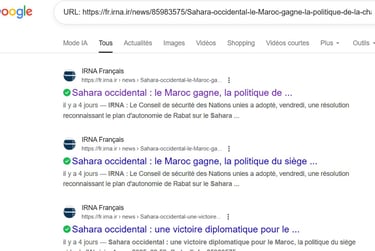
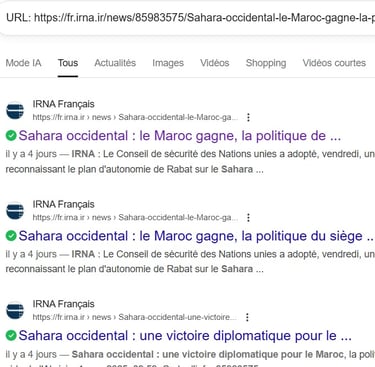
This isolation is also evident in the reaction of Iran, which is otherwise rather favorable to Algeria's positions on this issue. Through its official news agency, Iran criticized Algeria for its refusal to participate in the vote (the initial press release has been removed from the INRA's website as of November 4, 2025, but a cached version of the link is still available - see below).
Slovenia voted in favor of the resolution despite the gas contracts signed with President Tebboune during his visit in May 2025, and South Korea followed suit, despite the visit of Algerian Chief of Staff Saïd Chengriha in October.
By abstaining from the vote, Algeria sought to avoid both direct confrontation with the United States, which sponsored Resolution 2797, and the humiliation of an obvious defeat in the vote (11 to 1), which would have isolated it even more visibly.
Geopolitical consequences
1.Internal consequences
In Morocco
The vote on Resolution 2797 was widely celebrated in cities across the Kingdom, hailed as the culmination of a 50-year struggle. It will help strengthen social cohesion after the unrest that swept the Kingdom in early October (GenZ Movement).
The King of Morocco's speech refrained from any triumphalism, and the sovereign extended a hand to Algeria from a position of strength achieved through years of diplomatic work.
In the same speech, the King of Morocco referred to an acceleration of economic sovereignty, including by abstaining countries such as Russia.
“Furthermore, recognition of the Kingdom's economic sovereignty over its Southern Provinces has spread widely after major economic powers such as the United States of America, France, Great Britain, Russia, Spain, and the European Union decided to encourage investment in these provinces and promote trade with them.” [loose translation]
The resolution will thus enable Morocco to attract even more foreign capital for direct investment in the Sahara.
Internal Risks
The integration of “people returning from the Tindouf camps,” as proposed by King Mohammed VI in his speech, will pose significant challenges in the long term:
How will the Morrocan public react to the potential return of former Polisario members to the national community?
How can the future possibility be countered that these same elements will campaign for the independence of the “Southern provinces” within the framework of the democratic process envisaged by the autonomy plan?
In Algeria
Western Sahara has been presented as a national issue in Algeria, with the country recalling its ambassadors after the French and Spanish recognitions.
This resolution represents a clear defeat with 11 votes to 0 in the Security Council, with Algeria seeking to avoid this final result by not participating in the vote.
Internal Risks
Such a setback on a crucial diplomatic issue will inevitably raise questions among the Algerian public, leading to possible demands regarding the merits of supporting (militarily, financially, diplomatically) a losing cause.
The result could lead to a dynamic of rushing headlong into the future, with President Tebboune finding himself hostage to a confrontational foreign policy that serves mainly domestic political purposes, but which he cannot interrupt because doing so would amount to admitting defeat, forcing him to take actions that are increasingly unjustifiable from the point of view of the population.
The turn of events on this crucial issue, which is both a pillar of Algerian foreign policy and a motive for internal mobilization against the external enemy, could create divisions within the military apparatus, with some clans wanting to maintain the hard line and its historical military support to the Polisario Front, while others may want to give ground on this issue so as not to antagonize the American superpower.
2. International consequences
New bilateral recognitions of Morocco's sovereignty over the Sahara could emerge, as these would now be consolidated by the multilateral recognition provided by Resolution 2797.
This multilateral recognition will enable the most reluctant countries (e.g., Scandinavian countries) to take the step toward bilateral recognition. Furthermore, these recognitions will now be less vulnerable to democratic changes in these countries, since Morocco's proposal has now been validated by the UN.
When MINURSO's mandate is reassessed in six months' time, there could be talk of non-renewal in October 2026, since the referendum option no longer appears explicitly in the resolution.
This would also raise the question of the buffer zone representing 20% of the territory, with a possible takeover by Morocco and a withdrawal of MINURSO peacekeepers.
Increased pressure could be exerted on Algiers by the international community to conduct a census of the populations in the Tindouf camps, as the resolution states expressively: “Noting with grave concern the inadequacy of funds allocated to Sahrawi refugees and urging donors to provide additional funds, while reiterating its call for the refugees to be duly registered.” (loose translation - link with full text not available in English yet)
Prospective scenarios
Scenario 1: Consolidation of Moroccan autonomy without bilateral negotiations Probability: 50%
Multilateral recognition leads to a cascade of new bilateral recognitions
Gradual marginalization of the Polisario Front and Algeria's position, but no bilateral negotiations between Morocco and Algeria (diplomatic status quo)
Foreign Direct Investments accelerate in phosphates and port infrastructure in southern Morocco
A resumption of cooperation between Russia and Morocco could materialize, particularly with regard to the supply of modular reactors for seawater desalination, for example.
Acceleration of the Morocco-Nigeria gas pipeline project.
China and Russia would tolerate this development in Morocco's favor because of strategic investments in the country (Chinese billion dollar investments in gigafactories and fishing agreement with Russia), while the United States and the European Union would remain favorable for the same reasons (e.g., E-U Morocco trade deal).
Scenario 2: Bilateral negotiations between Morocco and Algeria (with US mediation) - Probability: 25%
Imposition of a “Pax Americana” : President Trump's advisor, Steve Witkoff, had suggested that negotiations were already underway between Morocco and Algeria under US auspices.
The King of Morocco's extended a cooperative hand to president Abdelmajid Tebboune in his speech on October 31, 2025. Morocco agrees to engage in negotiations, especially considering it's now in a position of strength following Resolution 2797.
Algeria, is forced to negotiate, faced with the risk of targeted sanctions in the event of persistent roadblocks in the negotiation process, and the risk of seeing the Polisario Front recognized as a terrorist organization, (and therefore, the real possibility of being designated by association as a rogue state).
Gradual cross-border cooperation on symbolic projects, such as cross-border water resource management is established. Possible reopening of borders and Algerian airspace to aircraft registered in Morocco.
Through this approach, the United States gains control over the natural resources of both countries: regaining parts in the phosphates industry in southern Morocco and mineral and oil and gas resources in Algeria.
The Algerian market gradually opens up to foreign capital. Russian and Chinese influence declined as a result, with the region gradually shifting under American protection.
Scenario 3: Diplomatic and security escalation - Probability: 25%
The Polisario, cornered, rejects negotiations and resumes armed struggle. This would be a risky option, as taking arms against the autonomy plan would amount to opposing a UN resolution.
Resumption of border skirmishes, influx of refugees to Mauritania and neighboring countries.
Security contagion in the Sahel develops through alliances with jihadist movements.
Morocco takes advantage of this insecurity to gain control over the buffer zone by military means.
If the security situation were to deteriorate, the Algerian government could ultimately disassociate itself from the Polisario Front to save face.
Important note: There is a degree of irrationality among certain actors that could lead to escalation; therefore, any form of prediction is perilous, as it does not take into account the factors of human psychology and the randomness of events.
Furthermore, a combination of the first two scenarios is a relatively high possibility, with Morocco continuing its diplomatic advance and Algeria agreeing to direct or indirect negotiations.
Monitoring
Monitor official announcements by the leaders of both countries and the major powers to identify any possible shift in rhetoric toward one scenario or another;
Monitor developments within the OAU (African Union), where the SADR has official status, as Morocco will undoubtedly seek to change this status;
Monitor possible troop movements or logistics convoys along the Sand Wall or the border using a tool such as Maxar;
International reactions: Monitor upcoming recognition of the autonomy plan and the dynamics of support or lack thereof for negotiations between Morocco and Algeria by countries that have not yet taken a position on the issue (e.g., Italy, Canada). This could indicate an even greater shift toward the autonomy option.
Conclusion
Overall risk: LOW
The trend is towards a peaceful resolution of the dispute, with Moroccan autonomy as the framework, and a maintenance of the diplomatic status quo between Morocco and Algeria.
The next milestone is the strategic review of MINURSO in April 2026.
Each country will now have to take a stance on the autonomy solution, which is now enshrined in international law, while balancing the positions of both Morocco and Algeria to take into account their strategic interests on both sides of the border.
@NorthAfrica Intel
November 2025
Classification : Public
@NorthAfrica Intel